What to wear? and what to bring…
All you need for your first class is some comfortable gym clothes (t-shirt/vest, shorts/joggers) and an open mind. You don’t even need any shoes, as we train barefoot.
The Essentials
Bring a water bottle. Our venue has a fully functional kitchen with drinking water so you can top up your bottle.
You may also want to bring a towel. If you go full effort for the whole class, then our warm up and techniques can be a fun but sweaty cardio workout. Holborn House has showers in the male and female changing rooms (but not in the accessible changing room) – but please note the water isn’t the warmest!
Once you have paid your membership you will also want to get a few essential things to make training more fun…
The White Uniform
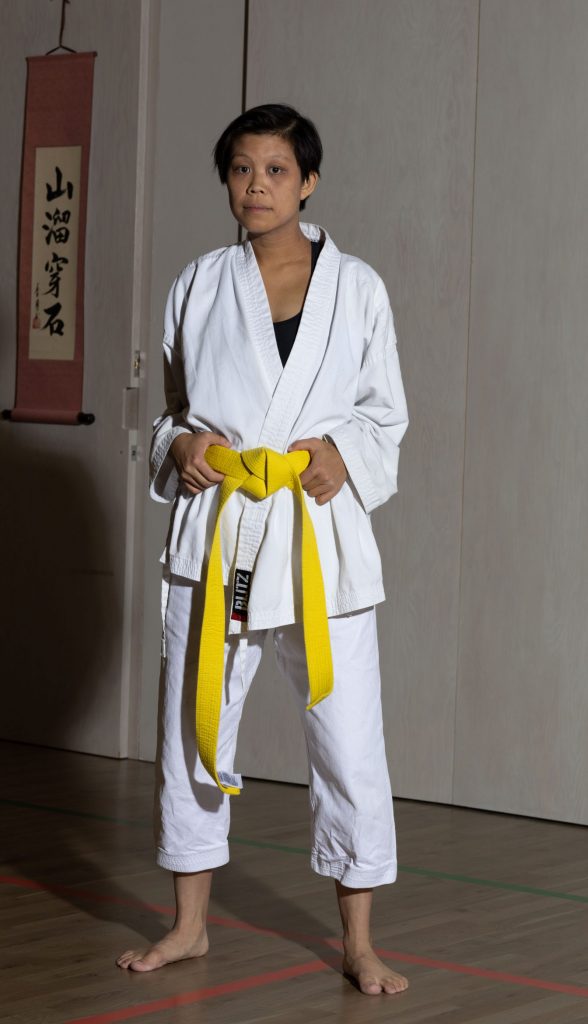
Our white uniform is called a dogi. We keep some for sale in our Holborn House venue where we run our beginner session. There is no set regulation for the kit so you can buy any dogi. We recommend the Karate uniform from Decathlon, Blitz or Amazon.
To grade you will need a BSKF badge which is also available for £5 from the club. We have several optional arm badges as well.
You may wish to wear something under your dogi as some techniques simulate clothing grabs. For maximum comfort for those who need one, we highly recommend a specialised high impact sports bra from a well known sports brand.
What you need to grade
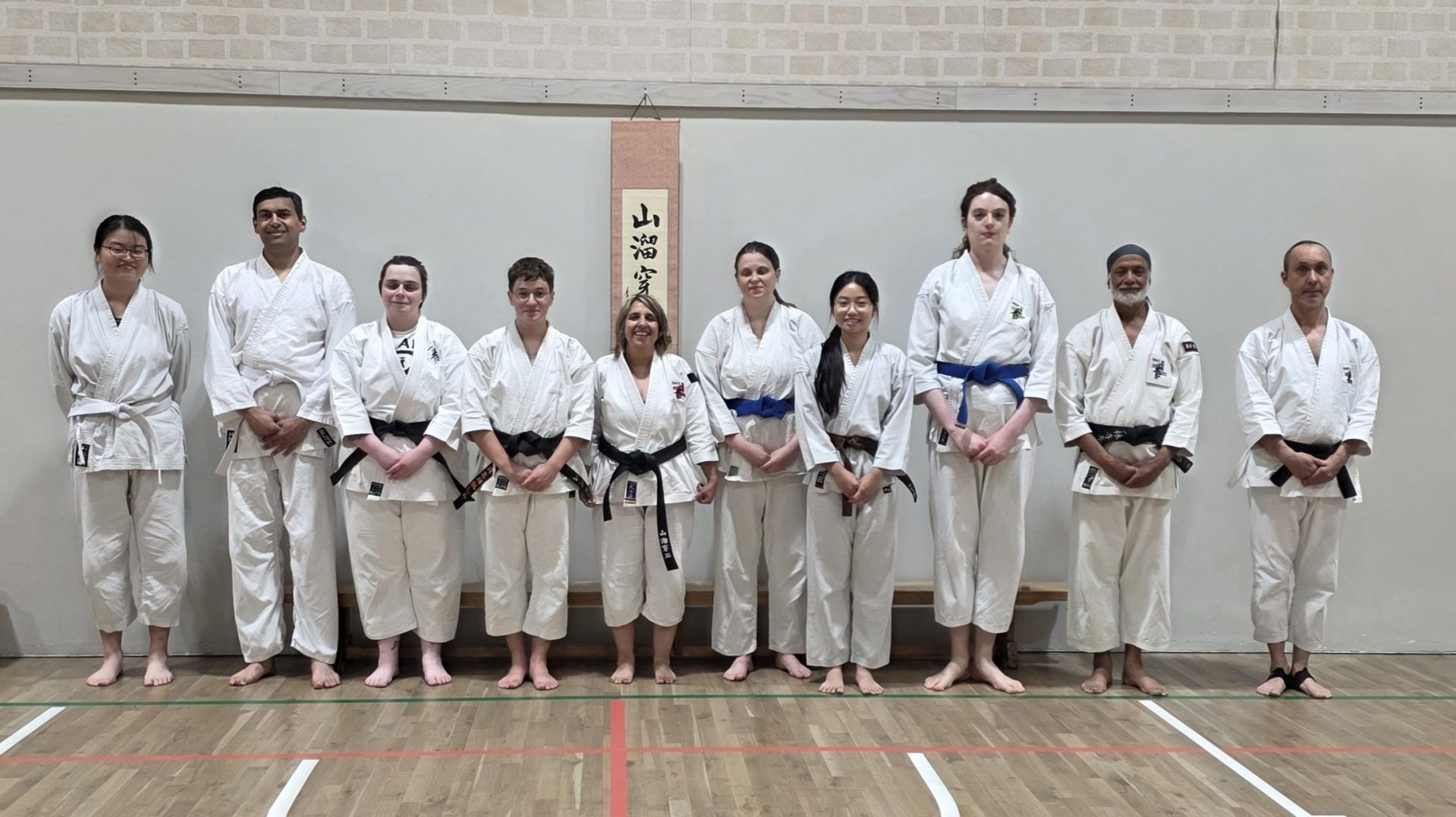
To get a black belt in this sport you first need to earn a yellow, orange, green, blue and then a brown belt. The club will loan you these belts each time you pass a grading. When you earn a black belt, we let you buy your own! We have a club tradition (started by one of our first students) of adding a rainbow ribbon to the end of our belts.
Are you ready to grade? Then, everything you need to know for the grading itself is listed in the BSKF Kyu grade syllabus. Ask our Club Captain for your copy. Our classes will explain everything you need to know about the techniques to be examined.
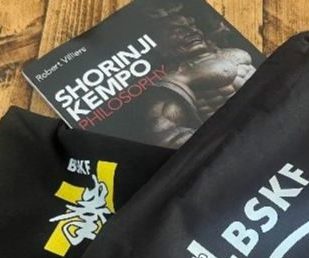
We are one of the few Martial Arts that makes philosophy core to the training. We therefore highly recommend getting your own copy of the official Philosophy Book. The club has one that you can borrow.
Optional – Pad Work
Pad work is one of the most enjoyable parts of training. It’s your chance to practice basic techniques at full speed and power without accidentally launching your training partner across the dojo. While none of the equipment below is essential when you’re starting out, many students choose to pick up their own kit as they train more regularly.
Gloves
While gloves aren’t required for most classes, many students choose to buy their own for pad work and competition training. Most of our instructors use lightweight MMA gloves. If you’re planning to compete, the BSKF currently requires either 4oz MMA gloves or Elastic Hand Pads.
If you also train in boxing or kickboxing, you may want a pair of boxing gloves as well. As a bonus, you’ll never have to wonder who wore them last.
Optional – Sparring, Randori

If you like boxing or sparring then you will want to apply all the things we teach you in a free form fight – safely. The BSKF and International Kempo Associations hold tournaments with a category called Randori (sparring). You also need to complete a bout of Randori during your grading to achieve your black belt. The following is the equipment we recommend. You should consider buying your own kit to break in before a tournament. For the purpose of grading most of it can be supplied by the us, or the BSKF.
Hand wraps
Hands are so important aren’t they? So let’s get them protected. Decent quality wraps are available everywhere. If you find some rainbow ones will you let us know? Make sure to get 3.5m or 4.5m (180inches) wraps, to ensure maximum protection. A great method to wash your wraps is to drop them in a pillowcase (or a laundry net) to avoid having that annoying untangling process at the end. Then use those gloves you have for pad work.
Gums Shields / Mouthguards
Mouthguards are used to protect your teeth, mouth, gums and jaw from any injury. They are optional. Entry-level mouthguards are made to mould at home (known as a boil-and-bite). It comes in a shape that will fit any jaw.
Headguards
The BSKF mandate a space helmet style guard with a clear shield for Tournaments. Our instructors are using the Kudo Space Helmet.
Groin Guards
All Tournament (Taikai) entrants must wear a groin guard. Either under or over the trousers. Our favorite are the shorts from Decathlon with a removable groin guard.
Body Protectors
As a Tournament entrant and optionally at gradings, you will be expected to wear body protectors which ideally has a double skin. As these are imported from Japan, the BSKF will supply these.
Foam shin/instep guards
These are optional but great for kicking pads and permissible in a tournament.
Weapons
Everyone at Camden Kempo has the opportunity to train with weapons. Just ask an instructor the next time you’re in the dojo.
For black belt grading, kenshi are expected to demonstrate one of three traditional Shorinji Kempo weapons: the shakujo (錫杖), nyoi (如意, sceptre or baton) or dokko (独鈷, palm-stick). These were likely chosen by Doshin So because they would have been familiar objects within a Shaolin temple environment and, if needed, useful things to have to hand in a fight. Monks, it turns out, occasionally had practical problems too.
As Shorinji Kempo moved from temple settings into universities, sports halls and community centres, weapons training became less prominent and many techniques gradually faded from regular practice. It’s hard to find time for ancient weapons when you’re trying to finish training before the caretaker locks up the hall.
Fortunately for us, BSKF Founding Chief Instructor Mizuno Sensei studied directly under the renowned shakujo master Ueda Sensei. Thanks to those efforts, these weapons remain part of the higher-grade syllabus in the UK today.
We’re still learning ourselves. The good news is that everyone starts as a beginner. The bad news is that waving a shakujo around gracefully is considerably harder than it looks.
Shakujo (錫杖) – Mandatory for Black Belts
At black belt it is mandatory to grade on our Shakajo (bo staff) syllabus. Shakajo (or Khakkhara) has a long history associated with East Asian Buddhist monks who used it to announce their presence and occasionally persuade wildlife to keep its distance. The Shakajo we train with is similar to a Bō or staff and perhaps best known outside of Camden for being Donatello’s weapon of choice in the Teenage Mutant Ninja Turtles.
At first glance a Shakajo looks a bit like a bo staff that’s been customised with a metal sculpture by a particularly enthusiastic monk. Like a standard staff it helps develop balance, coordination, timing and distance, but the distinctive metal rings add their own challenges (and soundtrack).
Our Federation, the BSKF, has not yet mandated any regulations for weapons. You might wish to start, by training with a standard 6ft bo staff made from a hardwood. You can buy bo staffs online, order weapons from specialist martial arts suppliers, or, like Sensei Kavita, wander into a hardware store with a measuring tape and an idea.
If you would like a proper shakujo head, Sensei Kavita has found a wonderful store in Kyoto, Japan that we recommend highly.
Whatever option you choose, we strongly recommend a carrying case. Walking through Camden carrying an unconcealed six-foot staff is a fantastic way to meet the public, the police, and occasionally both at the same time.
Please transport all training weapons safely and responsibly. We’d much rather talk about your latest grading than explain why your shakujo appeared on social media.

Dokko (独鈷) – Completely Optional
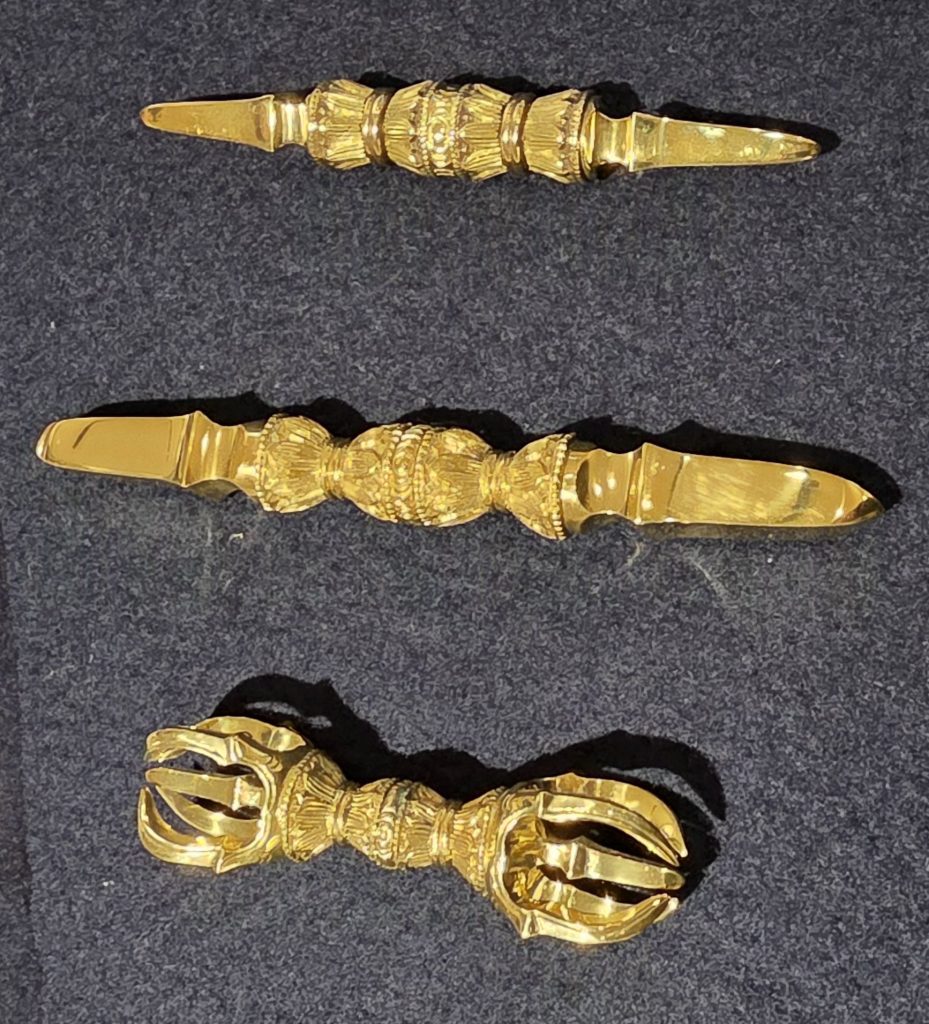
The dokko is the easiest weapon in kempo to underestimate. Most people seeing one for the first time assume it’s a religious artefact, an unusual paperweight, or something that belongs in a museum display case. In fairness, they’re partly right.
The dokko is derived from the Buddhist vajra, concealed within a monk’s hands during Buddhist prayer today. While most people in the dojo encounter this connection through Rei rather than any religious practice, it is an good reminder that many of the traditions we practise have deeper roots than simply hitting other people.
For the BSKF, the dokko is primarily studied through kata and forms. The examples shown here were sourced during Sensei Kavita’s shopping trip to Kyoto. Like many martial arts adventures, it started with a straightforward plan and ended with spending far more time but less money than originally intended. The shop wasn’t a Tokyo or London style martial arts supplier but a traditional Buddhist store. A monk arrived to collect provisions and chanted prayers before leaving. It was one of those moments that reminds you these objects are not just training tools. They are part of a living tradition.
Also, it’s worth noting that travelling halfway around the world to buy a small metal object is an adventure. Explaining that decision to customs was not. Shop, travel and train safely.